

This week: part two of the top ten strangest, most dangerous and most beautiful places I’ve taken ‘My Name Is Swan’. Plus when it’s appropriate to drop the ‘P’ bomb and the etiquette of performing poetry when your audience isn’t wearing shoes…
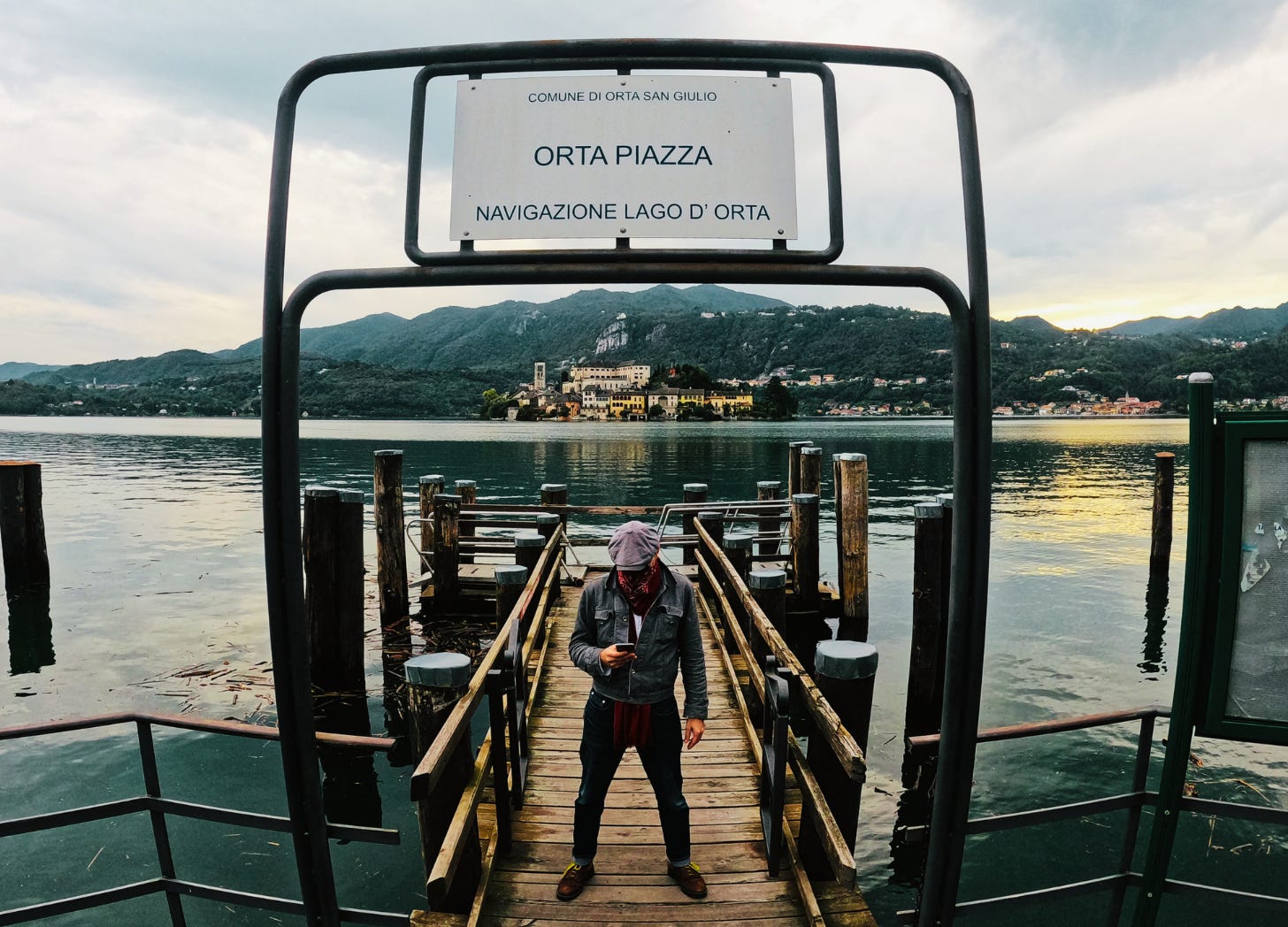
5. Poetry on The Lake, Orta, Italy
Former UK poet laureate Carol Ann Duffy described it as perhaps the most beautiful poetry festival in the world. And she’s not wrong. It deserves an entire essay. An idyllic setting, a lake, swans, catering. It has everything.
After a few years swanning around boozers in England, reading My Name Is Swan in numerous haunts and hovels, I thought it was about time Swan spread his wings.
Poetry on The Lake is a rarity, a festival where the work, yes the work and not simply how impressive your CV appears, can earn you a spot and in 2017 I was programmed to appear with the aforementioned C.A.D. at five star hotel on the Lake Orta shoreline. I had arrived.
The problem with arriving is that it is a singular moment. The train pulls away and you are left alone on the platform. After the reading I was gathering my papers as the great and good congratulated each other. I was approached by a well respected poet, dean of a leading UK university, and it felt as if Swan, who had spent his poetic life until this point drifting on the fringes, was finally going to be welcomed in. Swan preened his feathers, I stood ready and the poet asked, “Do you ever read your poems normally?”
Strange rating: 1/10
Danger rating: 0/10
Beauty rating: 9.5/10
4. The Original Swan, Oxford
Strange rating: 4/10
Danger rating: 6/10
Beauty rating: 0/10
This entry should carry a threat level rather than a danger rating. It might score higher. Pubs that have their furniture bolted to the floor generally provide for the kind of clientele whose night is incomplete without a bout of good, honest furniture throwing. Pubs that have their furniture bolted to the floor should be avoided if it’s an evening of witty, literary repartee and carefree, gay banter that you’re after. Pubs that have their furniture bolted to the floor are generally not great places to perform poetry in.
There are two Oxfords. Town and gown. Your image of Oxford is most likely based on the second, a vision of dreaming spires, punting and cucumber sandwiches, handsome chaps in varsity jumpers, pretty girls on basketed bicycles, the nation’s future leaders, engineers, poets. While this is all true there is another Oxford.
There is another Oxford as there is another England. Beyond flint and brick cottages, teashops and cricket greens, if you follow the main road out of town, past the vape stores and chicken joints you will find it, out here where the money runs out, out here where the money never comes, where cockney meets country you may find the Original Swan.
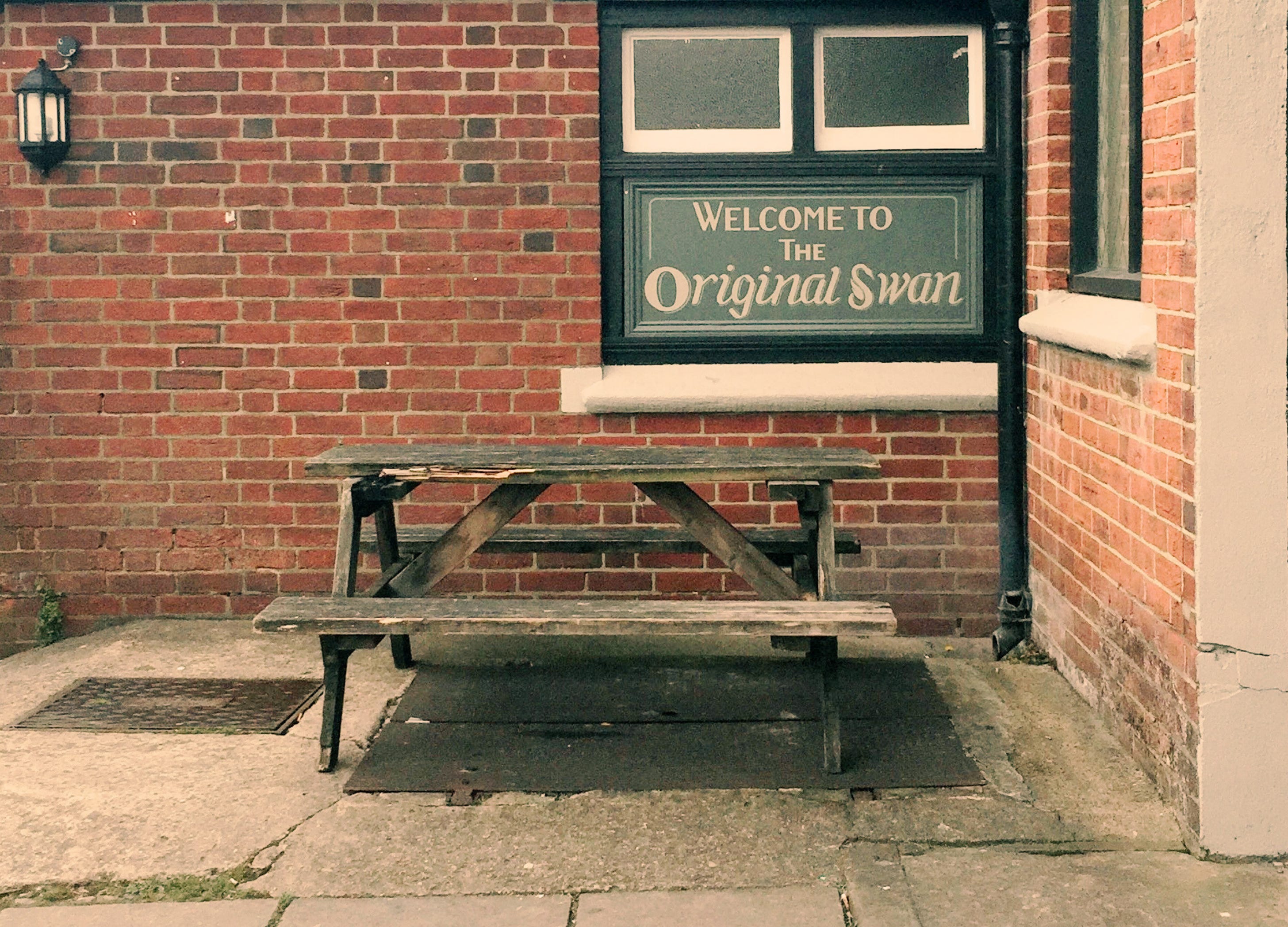
This happened ten years ago. Picture it: A man, in late middle age with the complexion of a well weathered cricket ball, unwashed hair, loose fitting tracksuit bottoms and a faded, beer-brand T-shirt is standing opposite me. In a pub carpark. In his socks.
He’s big but he’s out of shape. He’s not threatening me specifically, he’s just threatening with his presence and if this escalates I don’t fancy my chances. He unscrews a two-piece pool cue, holds one part in each hand, club and spear, and taps the blunt end against his calf. He is, I realise, the owner, the landlord, the governor of the Original Swan.
At this point I am a decade in to what we’ll call my ‘literary career’, a decade since I first submitted a manuscript and I’m beginning to think that things aren’t quite moving in the trajectory that I expected when the landlord asks, in his best Estuary English, “What the fuck are you doing in my pub?”
“I’m reading a poem,” I say backing away a little without giving the impression that I’m backing off entirely.“Reading a poem?” he says caught a little off guard. If you drop the ‘P’ bomb in company it can go either way. Generally you’ll get a few seconds grace before you’re either laughed at or met with some form of frowning or sympathetic interest.
My tactic was working. The confrontation dropped in temperature and could now be measured on the bewilderment scale. “You were reading a poem? In my boozer?” he shook his head, “You know half of ‘em in there can’t read or write don’t ya?” “I’ll read a little out here if you like?” I say. “Why don’t you jog on into town and read it to the toffs?” he says. “They don’t wanna hear it any more than you do.” I tell him.
I had come to Oxford, to this great seat of learning, this enchanted chair that has produced poets such as W.H. Auden, Cecil Day-Lewis, Alice Oswald, Glyn Maxwell, James Fenton, Wendy Cope, Craig Raine, Tom Paulin, Vikram Seth, to name just a few, because there was a literary festival taking place here.
It was no surprise that I’d not been invited to participate, that I was unlikely to be elected keynote speaker anytime soon. Festivals have their own landlords and governors, they too stand their ground, they too wield pool cues, metaphorical ones.
I had written to the Oxford Literary Festival expressing my interest, proposing my involvement, knowing full well I’d not get an answer. My enquiry simply an act of knocking at the door, to let them know that Swan was here, that Swan was ready, that Swan was waiting. We were not expecting to be let in. Besides, we had plans. We were going to read at their fucking festival whether they liked it or not. I created an event, off schedule, un-programmed, announced on social media and the Original Swan was our first port of call.
And here I am, standing in the pub’s carpark with a man in his socks who is holding two parts of a pool cue in both hands. “They don’t want nothing to do with us,” he says gesturing in the direction of the Magdalen College Tower. A sadness has come to him now, as if he has been left out, as if he’s not welcome, as if he has just this patch of ground to defend. “It’s a shame,” I say, “Poetry should be for everyone.” And for a few seconds we are the same as each other, two kids out in the school yard, excluded from class, having little in common but this quick solidarity of not belonging.
“So, what’s it about then, this poem of yours?” he asks.
“Well,” I say, “it’s…”
Next up: The concluding part of the strange, the dangerous and the beautiful…
Nº80 All at sea with Swan...

This week: The concluding episode of the top ten strangest, most dangerous and most beautiful places I’ve taken ‘My Name Is Swan’. Plus a message from the King’s Swan Marker, waiting for an encore in a city centre boozer and refusing to sit at the captain’s table